Finding. Funding.Promoting.
|
PEACEBUILDER: Fay King Chung PROJECT: Envision COUNTRY: Zimbabwe RUNNING COSTS: £58,333 pa
“Life in Zimbabwe is still grim. But there are signs of hope – schools reopening, women having the courage to take their abusers to the courts.”
|
| Info | News |
|---|---|
Fay’s story
‘Even while we Zimbabweans were fighting for our independence in the ‘70s, we realised that our country was desperately underskilled. There were only 30,000 people in the whole country who had graduated from high school. So I and my colleagues trained 600 young people as teachers for the next generation. But come independence, with a desperate shortage of educated people across the board, many of the 600 now have positions of responsibility in key sectors. These high school students who joined the Liberation Struggle are now assuming leadership roles in every area of life, as teachers, in the security services, in the judicial system and in parliament. These war veterans had joined the Liberation Struggle out of a desire to create a better society based on democracy and human rights. Thirty years on as the Chair of the Womens’ University in Africa, I remain in touch with my students, persuading them to learn skills in conflict resolution which are so badly needed if Zimbabwe is to come out of conflict.’
How Envision works
Envision Zimbabwe started in 2009 with an ambitious three part programme.
- Identifying people in position of power who want to find new ways to resolve conflict, and working with Simon Fisher, founder of Responding to Conflict, Dekha Ibrahim Abdi and others to develop those skills in key institutions affecting both victims and perpetrators.
- Building a network of womens’ organisations, from across the political spectrum, from the grassroots to parliament, in order to build a consensus on the future of Zimbabwe and prevent violence in the next election.
- Introducing peace education across schools, and particularly for youths who have dropped out of school and are most likely to earn a living through violence and intimidation.
Key achievements
- Conflict resolution workshops have been held with leaders from community groups, churches, security services and civil society
- Together with the Women’s Coalition, including 40 womens’ groups, Envision has started addressing women’s concerns over water and security, as well as formulating women’s demands for the new constitution
- The Ministry of Education is signed up to the peace education initiative, with a view to creating a national curriculum
We say
‘Envision is persuading the people who have power to create change in Zimbabwe to look in a new direction. If they can link the pressure from a growing women’s coalition with the people in power who are open to change, then Zimbabwe’s elections next year could take the country forward, not backward.’ Carolyn Hayman, Chief Executive, Peace Direct.
How you can help
Envision needs funds for transport and food so it can move beyond its base in Harare to work with women across Zimbabwe. £15 buys food for ten women to share their experiences of insecurity and deprivation in a workshop and decide how to take collective action.
Mar 2010 Working with women in Zimbabwe
Mbuya Mambiro has seen a lot in her long life in Zimbabwe. But the last two years have been the hardest. Since the elections of 2008, she has lived with the daily fear of political violence and the collapse of local services.
As a mother living in a sprawling township, her worst fear has been cholera. In 2008 as political chaos spread, her town council cut off the water supply to people’s homes and schools. She and her neighbours crowded round boreholes and streetside taps to gather water for their cooking and washing. Others drew it straight from the river, though the waters were contaminated with sewage.
Two years on, the streets of her town are still awash with sewage from rusting pipes that burst with sickening regularity. The health risks are obvious to residents who must jump across mounds of uncollected rubbish to reach their own front doors. And there still isn’t enough water: Harare needs 13 million tonnes of water a month, but only receives seven.
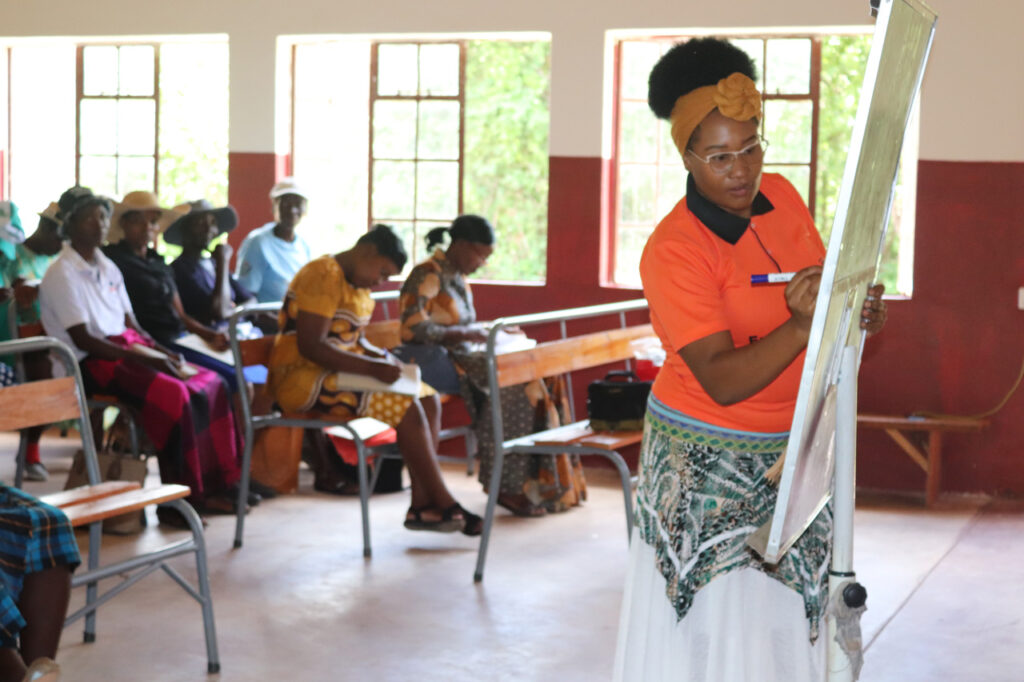
Into this situation stepped local peacebuilding organisation Envision Zimbabwewhich held a township meeting with 30 local women, to see what they could do for themselves about water, waste and public hygiene.
The women came from all walks of life and all political groupings – women split apart by the violence of the times. Working together was unusual. Uniting on a common issue they began to rebuild bridges between their communities. One woman, Mai Kanoyerera, spoke out: “There is a lot we can do as women to help our communities help ourselves.”
They decided to organise a clean-up of the township, and to set out ways for the town to keep itself clean – by small things like not scrubbing pots with sand in the sink, or fixing central collection points for everybody’s rubbish. And they asked Envision to help them to meet the city council.
Chipo Chung from Envision was there on the day the clean-up began. “I was in awe of these women, equipped with donated protective gear – gumboots, gloves, face masks – enthusiastically throwing themselves into gutters that were knee-high in human waste, sewage and rubbish, and clearing it out by hand. The stench was gut-renching, I was gagging because it smelt so bad. But these women, some old enough to be my grandmother, worked without stopping for four hours!”
Mai Kanoyerera adds: “We were surprised to hear from Envision that we can actually make money from recycling rubbish that we usually just throw away. For example, we can melt down plastics to make paraffin or floor polish. We can make compost from all the vegetable matter we discard, to grow more food for our families around our homesteads. So we decided to get bins to sort the rubbish that can be recycled.”
For Mbuya the fear of recent years is beginning to subside. “We needed to show ourselves and our neighbours that we have the power to do much to clean up our neighbourhoods, to create healthy places for our children to play, to restore the dignity of our living spaces.
“Once we piled up the rubbish in specified locations, we did get the council to come and collect it. Now, with the help of two engineers, found through Envision, we will solve our water and sewage problems. And we are looking at how we can earn income by turning our waste into ‘gold’.”
Jan 2010 a look back on 2009 – Zimbabwe
”We need to get youths to understand that if we disagree, the solution is not to kill each other. We want to build a movement of youths who cannot be used as cannon fodder in political games.” Fay Chung, Director of Envision
In November Envision held its first interfaith workshop in the rural area of the Murehwa District. Murewha was victim to the post election ‘re-education’ campaigns in 2008 and as such the area is very sensitive to ‘outsiders’. NGOs have previously been chased out of the area, and it is only through Envision’s ‘local’ status that it was able to run projects there. The workshops focused on developing the idea of a Peace Education Curriculum, and identified young people who could take part in focus groups
Envision will use the focus groups to ensure their work will always be informed by and in response to the needs of Zimbabwe’s youth. The challenges the participants face in their everyday life show in microcosm the problems facing the country as a whole. Half of the participants had lost one or both parents and were responsible for bringing up their younger siblings. Whilst nearly all of them had completed schooling, many of them had left without qualifications and the majority of them had no employment.
Envision also aims to apply practical solutions to issues, such as water shortage or poor sanitation, that lead to conflict within communities. They have set up a clean water campaign, working with women in rural Mbare, and in January they will launch a ‘clean up campaign’ to promote better waste collection in slum areas.
2010 will be an exciting year for Envision. They will continue and expand their workshops in rural areas such as Murehwa and develop their peace education programme to prevent youth being used as tools to perpetuate political violence
”The only jobs we can find are as cotton pickers, maids, prostitutes, thieves, street vendors and other jobs open to street kids.“ A Cool Heads graduate
With Envision’s help 2010 may offer some of these young people a more promising alternative